Soprano Titanium
₨1,350,000
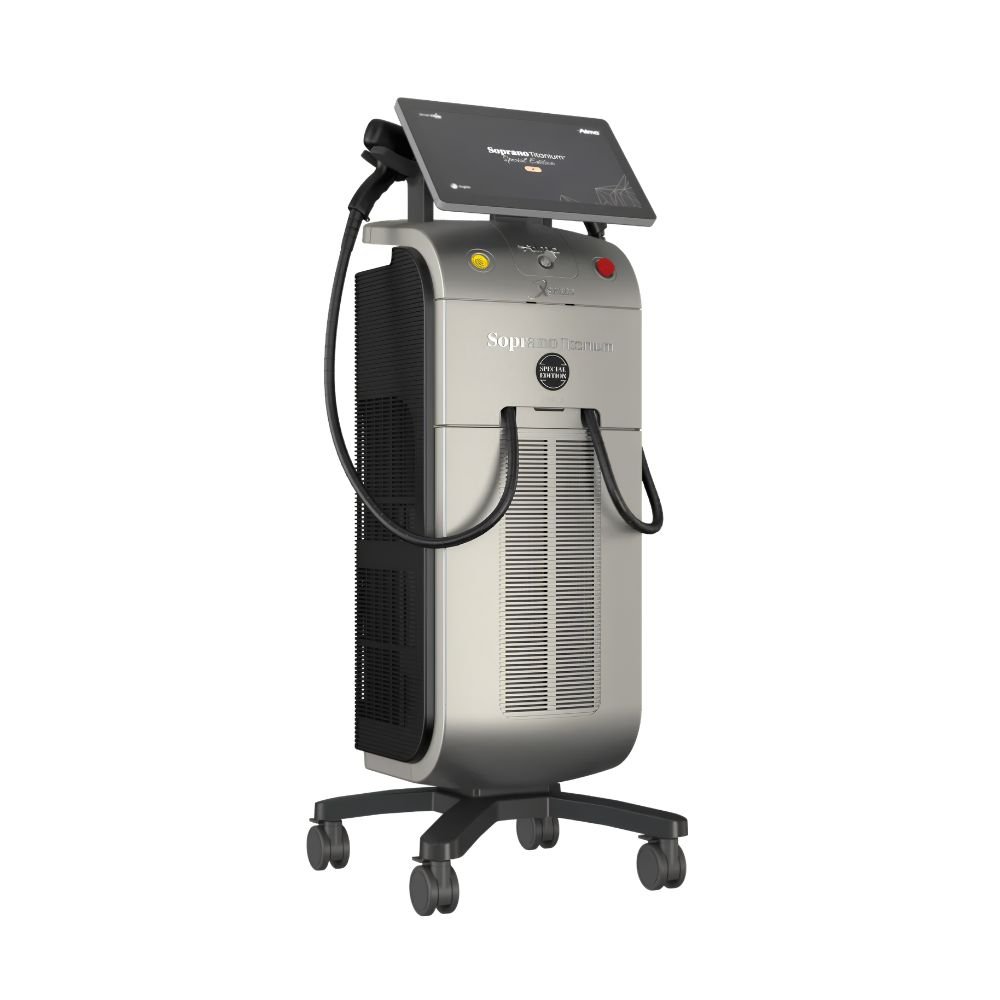
The Soprano Titanium laser machine is a professional laser hair removal system designed to combine multiple laser wavelengths, gradual dermal heating, continuous contact cooling, and in-motion treatment techniques. Its technology is intended to support hair reduction across different body areas while helping practitioners manage treatment comfort, coverage, and workflow efficiency.
For aesthetic clinics, dermatology practices, and professional laser treatment centres, understanding the machine’s technical features is essential before selecting equipment. Wavelengths, energy delivery, spot size, cooling performance, treatment protocols, and handpiece configuration all influence how a laser system is used in clinical practice.
This guide explains the technology behind the Soprano Titanium laser hair removal machine, its key features, clinical applications, and the specifications professionals should assess when considering a purchase.

Need Help? Chat with an Expert
Global Equipment Delivery
Cost Effective Solutions
Professional Support
Secure Payment
Details
What Is a Soprano Titanium Laser Machine?
The Soprano Titanium is a professional laser hair removal platform that combines three wavelengths—755 nm, 810 nm, and 1064 nm—in a simultaneous-emission configuration. These wavelengths interact with melanin at different levels and can contribute to targeting hair follicles at varying tissue depths.
The system incorporates Super Hair Removal (SHR) technology, an in-motion treatment approach, and ICE Plus contact cooling. Together, these technologies are designed to deliver laser energy progressively while cooling the skin’s surface during treatment.
The platform is intended for professional hair reduction procedures performed by appropriately trained practitioners. Treatment outcomes depend on factors such as hair colour, hair thickness, skin phototype, hormonal influences, treatment parameters, and adherence to an appropriate treatment schedule.
How Does Soprano Titanium Laser Hair Removal Technology Work?
Laser hair removal uses selective photothermolysis, a process in which light energy is absorbed by a target chromophore and converted into heat. In hair reduction, melanin within the hair shaft and follicular structures acts as the primary target.
When suitable laser parameters are used, thermal energy can damage structures involved in hair growth. The objective is to reduce future hair growth while limiting unnecessary heating of surrounding tissue.
The treatment process involves several interacting components:
- Wavelength selection: Different wavelengths have different absorption and tissue-penetration characteristics.
- Energy delivery: Fluence, pulse duration, repetition rate, and treatment technique influence the thermal response.
- Follicular heating: Sufficient thermal exposure is required to affect hair-producing structures.
- Epidermal protection: Appropriate cooling, parameter selection, and technique help manage surface heating.
- Treatment scheduling: Multiple sessions are usually required because hair follicles cycle through different growth phases.
The Soprano Titanium platform combines multiple wavelengths with gradual heating and contact cooling to support this process.
Triple-Wavelength Laser Technology: 755 nm, 810 nm and 1064 nm
One of the principal technical features of the Soprano Titanium system is its combination of three wavelengths. Each wavelength has distinct optical characteristics that affect how laser energy interacts with melanin and tissue.
1. 755 nm Alexandrite-associated wavelength
The 755 nm wavelength has relatively strong absorption by melanin compared with longer wavelengths commonly used for hair removal.
Its characteristics make it useful for targeting melanin in hair follicles, particularly when treating appropriately selected hair and skin combinations. However, the amount of melanin in the epidermis must also be considered because epidermal melanin can absorb laser energy.
Key characteristics include:
- Relatively strong melanin absorption.
- Useful interaction with superficial follicular structures.
- Potential application in treating finer hair when suitable pigment and treatment conditions are present.
- A need for careful parameter selection in more deeply pigmented skin.
Very light, grey, white, or minimally pigmented hair may respond poorly to laser hair removal because these hairs contain insufficient melanin to absorb the required energy.
2. 810 nm diode laser wavelength
The 810 nm wavelength is widely used in diode laser hair removal systems. It provides a balance between melanin absorption and penetration into tissue.
This wavelength can be used to target follicular structures at suitable depths while allowing practitioners to adjust treatment parameters according to skin and hair characteristics.
Key characteristics include:
- Effective interaction with melanin in pigmented hair.
- Penetration suitable for targeting deeper follicular structures.
- Application across various body areas.
- Flexibility in treatment planning when used with appropriate energy and pulse settings.
The response to 810 nm laser energy is not determined by wavelength alone. Fluence, pulse duration, repetition rate, spot size, cooling, and the patient’s skin and hair characteristics also influence the treatment.
3. 1064 nm Nd wavelength
The 1064 nm wavelength has lower melanin absorption than shorter wavelengths commonly used for hair removal. Its longer wavelength generally allows deeper penetration into tissue.
This optical profile can be advantageous when treating appropriately assessed patients with darker skin phototypes because it may reduce epidermal melanin absorption relative to shorter wavelengths. It does not eliminate the risk of burns, pigmentary changes, or other adverse effects.
Key characteristics include:
- Relatively lower absorption by melanin.
- Greater penetration into tissue compared with shorter hair-removal wavelengths.
- Potential usefulness for treating deeper follicular structures.
- A need for appropriate energy settings and epidermal protection.
Triple-wavelength technology comparison
| Feature | 755 nm | 810 nm | 1064 nm |
|---|---|---|---|
| Relative melanin absorption | Higher | Moderate | Lower |
| Relative tissue penetration | More superficial | Intermediate | Deeper |
| Primary target | Melanin in hair follicles | Melanin in hair follicles | Melanin in deeper follicular structures |
| Main consideration | Epidermal melanin absorption | Balance of absorption and penetration | Adequate follicular heating at suitable parameters |
| Clinical selection | Based on skin and hair assessment | Based on skin and hair assessment | Based on skin and hair assessment |
The three wavelengths provide different optical characteristics. Combining them does not mean that every patient requires the same settings or that all hair colours respond equally well.
What Is 3D Triple-Wavelength Technology?
The Soprano Titanium platform uses a triple-wavelength approach in which 755 nm, 810 nm, and 1064 nm wavelengths can be emitted simultaneously through a compatible applicator.
This configuration is designed to deliver energy with different absorption and penetration characteristics during the same treatment pass. Rather than relying on only one wavelength’s optical profile, the system combines multiple wavelength contributions to target follicular structures at varying depths.
Potential operational advantages include:
- A combined wavelength approach within one applicator.
- Flexibility when planning hair reduction treatments for different body areas.
- Reduced need to rely exclusively on a single wavelength.
- Integration with in-motion treatment delivery and contact cooling.
The clinical effect still depends on the delivered energy, the applicator configuration, the treatment protocol, and the patient’s individual characteristics. Triple-wavelength technology should not be interpreted as a guarantee of superior results for every patient.
SHR Technology: Gradual Heating and Repeated Energy Delivery
SHR stands for Super Hair Removal. In this treatment approach, laser energy is delivered through repeated pulses, often while the applicator moves over the treatment area.
Rather than depending solely on isolated high-energy pulses, the technique can build thermal exposure progressively. The objective is to heat the target structures sufficiently while managing the temperature of the surrounding skin.
The effectiveness of gradual heating depends on several variables, including:
- Energy delivered per pulse.
- Pulse frequency and duration.
- Number and overlap of passes.
- Movement speed of the applicator.
- Contact cooling and skin response.
- Hair pigmentation and follicular characteristics.
SHR is a method of energy delivery, not a separate wavelength. Its performance depends on the laser platform and the parameters used by the practitioner.
In-Motion Laser Treatment
In-motion treatment involves moving the applicator across the selected area while delivering repeated laser pulses. The technique differs from stationary stamping, in which individual spots are treated separately.
When performed with the appropriate protocol, in-motion delivery can help practitioners cover larger body areas systematically. Consistent movement and overlapping coverage are important because excessive gaps can leave areas untreated, while excessive energy accumulation can increase the risk of thermal injury.
The main operational considerations are:
- Maintaining consistent contact with the skin.
- Following the recommended movement speed.
- Using the correct number of passes.
- Monitoring the patient’s response throughout treatment.
- Avoiding excessive overlap or prolonged heating in one location.
In-motion delivery can support workflow efficiency, but treatment speed must never take priority over adequate coverage, patient comfort, and safety.
ICE Plus Contact Cooling Technology
Cooling is an important part of laser hair removal because the epidermis may absorb some of the delivered energy, particularly when it contains more melanin.
The Soprano Titanium system incorporates ICE Plus contact cooling. The cooling interface is designed to cool the skin’s surface during laser delivery, helping manage epidermal heating and improve treatment comfort.
The main functions of contact cooling include:
- Reducing surface temperature during treatment.
- Supporting epidermal protection.
- Improving comfort during repeated laser passes.
- Helping manage the thermal effects of energy delivery.
Cooling does not eliminate the risk of burns or other complications. The correct laser settings, appropriate patient selection, operator training, and continuous assessment of skin response remain essential.
Large Spot Size and Treatment Coverage
Spot size refers to the area exposed to laser energy with each application. A larger spot can cover more surface area per pulse and may improve treatment efficiency when the remaining treatment parameters are appropriate.
Some Soprano Titanium configurations feature a large-area applicator, including a 4 cm² spot size. The exact spot size and compatible handpieces depend on the system configuration.
A larger spot may be useful when treating areas such as the legs, back, arms, and other extensive body regions. Smaller treatment tips may be more suitable for certain facial or anatomically restricted areas.
Spot size should be evaluated alongside:
- Optical output and energy delivery.
- Fluence and pulse characteristics.
- Handpiece ergonomics.
- Cooling performance.
- Treatment-area requirements.
- Manufacturer-approved treatment protocols.
A large spot size alone does not establish the clinical effectiveness of a laser machine. It is one factor within the complete optical and thermal system.
Key Features of the Soprano Titanium Laser Machine
The following features are relevant when evaluating the platform for professional laser hair reduction.
Triple-wavelength delivery
The combination of 755 nm, 810 nm, and 1064 nm provides different melanin absorption and tissue-penetration characteristics in a compatible applicator.
SHR energy-delivery mode
Repeated pulse delivery supports gradual heating during appropriately performed in-motion treatments.
ICE Plus cooling
Continuous contact cooling helps manage epidermal heating during laser application.
In-motion treatment technique
The moving-applicator approach is designed to support systematic coverage of treatment areas.
Applicator options
Different compatible applicators can provide different spot sizes or wavelength configurations. Their availability depends on the particular system and package.
User interface and treatment controls
The platform includes a touchscreen interface for operating the system and selecting treatment parameters. Practitioners should understand the available controls, safety warnings, and manufacturer-recommended protocols before clinical use.
Dual applicator connections
Certain Soprano Titanium configurations support two applicator connections. This can provide workflow flexibility, depending on the installed applicators and system configuration.
Clinical workflow considerations
The combination of wavelength options, cooling, and applicator design is intended to support professional hair-removal workflows. Actual treatment duration depends on the area being treated, the patient’s characteristics, the selected protocol, and operator technique.
What Treatments Can the Soprano Titanium Laser Machine Be Used For?
The principal application of the Soprano Titanium laser platform is laser hair removal and long-term hair reduction.
Depending on patient assessment and the applicable treatment protocol, professional hair reduction procedures may involve:
- Facial hair reduction.
- Upper lip and chin hair reduction.
- Underarm hair reduction.
- Arm and leg hair reduction.
- Bikini-line hair reduction.
- Back and chest hair reduction.
- Hair reduction across larger body areas.
Not every treatment area requires the same settings. Facial skin, body skin, hair density, and anatomical characteristics differ, so practitioners must select parameters and applicators appropriately.
The system should not be assumed to treat unrelated skin conditions simply because it is a professional aesthetic laser. Indications should remain within the device’s intended use and applicable manufacturer guidance.
Which Skin and Hair Types Are Suitable?
Laser hair removal works primarily through the absorption of light by melanin. Consequently, hair pigmentation is an important factor in determining treatment response.
Dark, pigmented hair generally provides a stronger optical target than white, grey, or very light hair. Blonde and red hair may respond inconsistently depending on their pigment composition and the equipment used.
Skin phototype also affects treatment planning. Higher epidermal melanin levels can increase the risk of unwanted heating, making wavelength selection and energy settings particularly important.
Before treatment, a qualified practitioner should assess:
- Fitzpatrick skin phototype.
- Hair colour, thickness, and density.
- Recent tanning or sun exposure.
- Current medications and relevant contraindications.
- History of pigmentary changes or abnormal scarring.
- Previous laser treatments and treatment response.
- The intended treatment area.
No single wavelength or laser platform guarantees the same outcome for every skin and hair combination.
How Many Sessions Are Needed?
Laser hair removal typically requires a series of sessions because hair follicles do not all remain in the same growth phase at the same time. Laser treatment is generally most effective when the target hair contains sufficient melanin and is in a suitable stage of the growth cycle.
The number of sessions varies according to:
- Body area.
- Hair density and thickness.
- Hair colour.
- Skin characteristics.
- Hormonal influences.
- Individual response to previous sessions.
- The interval between treatments.
Some patients notice a reduction in hair growth after the initial sessions, but a single session usually cannot treat all follicles effectively across their growth cycles. Maintenance treatments may be appropriate for some patients.
Practitioners should explain that laser hair removal aims for long-term hair reduction rather than promising complete, permanent removal of every hair.
Soprano Titanium Laser Machine Specifications to Evaluate
When considering a Soprano Titanium laser machine for sale, prospective buyers should review the complete technical configuration rather than relying on the product name alone.
| Specification | Why it matters |
|---|---|
| Wavelengths | Determines the optical characteristics available for hair reduction |
| Laser type | Clarifies the light source and system architecture |
| Fluence range | Indicates the available energy density settings |
| Pulse duration | Influences the duration of energy delivery |
| Repetition rate | Affects pulse frequency and treatment workflow |
| Spot size | Determines the surface area exposed per application |
| Cooling technology | Helps manage epidermal heating and patient comfort |
| Applicator configuration | Determines available treatment modes and coverage options |
| Electrical requirements | Helps establish compatibility with the clinic’s power supply |
| User interface | Supports parameter selection and system operation |
| Safety interlocks | Helps manage operation-related risks |
| Service requirements | Affects maintenance planning and equipment uptime |
| Warranty and training | Supports ongoing operation and staff competence |
Exact values should be confirmed against the documentation for the specific system configuration. Do not assume that every device advertised under the same product name includes identical applicators or specifications.
What Should Clinics Check Before Buying a Soprano Titanium Laser Machine?
A professional laser system is a significant equipment decision. Buyers should evaluate its technical suitability, operating requirements, safety features, and long-term support.
1. Confirm the complete configuration
Request a written specification sheet listing the supplied applicators, wavelength capabilities, spot sizes, operating modes, and included accessories.
2. Review the laser output specifications
Ask for the manufacturer’s documented fluence range, pulse parameters, repetition rate, and applicable output specifications. Electrical input power and optical laser output are different measurements and should not be treated as interchangeable.
3. Evaluate the cooling system
Confirm how the cooling technology operates, how it is maintained, and what checks are required before and during treatment.
4. Inspect the handpiece and applicator
Assess ergonomics, cable condition, contact surfaces, controls, and the availability of maintenance support for the supplied components.
5. Review safety features
Check the operating manual, emergency-stop function where provided, warning indicators, protective eyewear requirements, and laser safety procedures.
6. Ask about training
Operators should receive appropriate training in laser physics, skin assessment, treatment parameters, contraindications, adverse-event recognition, and safe device operation.
7. Confirm warranty and technical support
Review the written warranty, coverage exclusions, maintenance arrangements, and procedures for reporting technical faults.
8. Assess operating costs
Consider electricity requirements, routine maintenance, consumables where applicable, handpiece servicing, staff training, and expected equipment downtime.
9. Request a demonstration
A demonstration can help the clinical team assess the interface, applicator handling, workflow, and suitability for the intended treatment areas.
Soprano Titanium Laser Machine Price: What Determines the Cost?
The cost of a professional laser hair removal system depends on its configuration and the terms included in the purchase.
Important cost factors include:
- The supplied system configuration.
- Included laser applicators and handpieces.
- Warranty duration and coverage.
- Installation and operator training.
- Technical support arrangements.
- Maintenance requirements.
- Included accessories and safety equipment.
- Delivery and commissioning terms.
A useful quotation should specify the exact equipment being supplied, its technical specifications, the warranty, training, installation, and any additional costs. Comparing quotations using these details provides a clearer basis for evaluating the equipment than comparing headline prices alone.
Laser Safety and Professional Operation
Laser hair removal requires appropriate assessment, equipment handling, and protective measures. Incorrect energy settings, unsuitable treatment selection, inadequate cooling, or excessive energy accumulation can cause burns, blistering, pigmentary changes, eye injuries, and, in some cases, scarring.
Professional operating procedures should include:
- Assessment of skin type, hair characteristics, and relevant contraindications.
- Appropriate wavelength and parameter selection.
- Manufacturer-recommended laser safety eyewear for the operating wavelength and exposure conditions.
- Protection of the eyes of the patient and everyone in the treatment room.
- Appropriate room controls and laser safety procedures.
- Skin monitoring during treatment.
- Documentation of treatment parameters and observed reactions.
- Clear aftercare instructions and follow-up when necessary.
A cooling system or a treatment mode marketed as comfortable does not replace these precautions. Laser procedures should be performed by appropriately trained personnel within their professional scope of practice.
Maintenance of the Soprano Titanium Laser Machine
Regular maintenance supports reliable operation and helps identify problems before they disrupt clinical services.
The maintenance schedule should follow the manufacturer’s instructions for the specific system and applicators.
Important maintenance areas include:
- Inspection and cleaning of approved contact surfaces.
- Checking the handpiece, cables, connectors, and applicator condition.
- Monitoring cooling-system operation.
- Checking ventilation and keeping air openings clear as instructed.
- Reviewing system warnings and error messages.
- Keeping maintenance and service records.
- Arranging authorised technical inspection when required.
- Following the manufacturer’s procedures for cleaning and disinfection.
Users should not attempt internal repairs or bypass safety interlocks. A device that displays persistent faults, has damaged components, or does not cool as expected should be assessed before further treatment.
Frequently Asked Questions
Is the Soprano Titanium a diode laser machine?
The platform is described as a multi-wavelength laser hair removal system incorporating 755 nm, 810 nm, and 1064 nm wavelengths. Its configuration combines different wavelength characteristics within a professional hair-removal platform.
What is the purpose of the three wavelengths?
The wavelengths have different melanin absorption and tissue-penetration characteristics. Their combined use is intended to provide a broader range of optical characteristics for targeting hair follicles at different depths.
What does SHR mean in laser hair removal?
SHR stands for Super Hair Removal. It refers to a treatment approach using repeated laser pulses and gradual heating, commonly combined with an in-motion applicator technique.
What is ICE Plus cooling?
ICE Plus is a contact-cooling technology designed to cool the skin’s surface during laser treatment. Cooling helps manage epidermal heating and may improve comfort, but it does not remove the risk of adverse effects.
Can the machine treat all hair colours?
No laser hair-removal system can be expected to work equally well on every hair colour. Hair with sufficient melanin generally provides a better target than white, grey, or very lightly pigmented hair.
Is the Soprano Titanium suitable for every skin type?
Treatment suitability depends on the patient’s skin phototype, hair characteristics, medical history, and the device’s approved treatment protocols. Practitioners must assess each patient and select appropriate parameters rather than assuming that one setting is suitable for everyone.
How many laser sessions are required?
The number of sessions varies by individual and treatment area. Multiple sessions are generally necessary because hair follicles cycle through different growth phases, and maintenance treatments may be needed.
What should I check before purchasing the machine?
Review the complete technical specification, supplied applicators, wavelength configuration, fluence range, pulse parameters, cooling system, warranty, operator training, maintenance requirements, and technical support.
Can the machine be used for skin rejuvenation or pigmentation treatment?
Its principal application is laser hair removal. Other uses should not be assumed without explicit confirmation in the manufacturer’s intended-use documentation for the exact system configuration.
Buy a Soprano Titanium Laser Machine for Your Aesthetic Clinic
Choosing a professional laser hair removal machine requires a clear understanding of its wavelength technology, energy delivery, cooling performance, applicator configuration, safety requirements, and maintenance needs.
The Soprano Titanium platform combines 755 nm, 810 nm, and 1064 nm wavelength technology with SHR energy delivery, in-motion treatment, and ICE Plus contact cooling. These features are designed to support professional hair-reduction procedures when the system is operated according to the appropriate protocols.
For equipment specifications, package details, and purchase enquiries, contact Aesthetic Clinic Machines.
Machine purchase and enquiries
Phone: 0333 7277272
Phone: 0300 7706050
Social media: @aestheticclinicmachines
Discuss your intended clinical applications, required applicators, training needs, warranty coverage, and technical support before making a purchase.